Find the Ancestor
Twelve suspects. One ancestor. Only evidence wins.
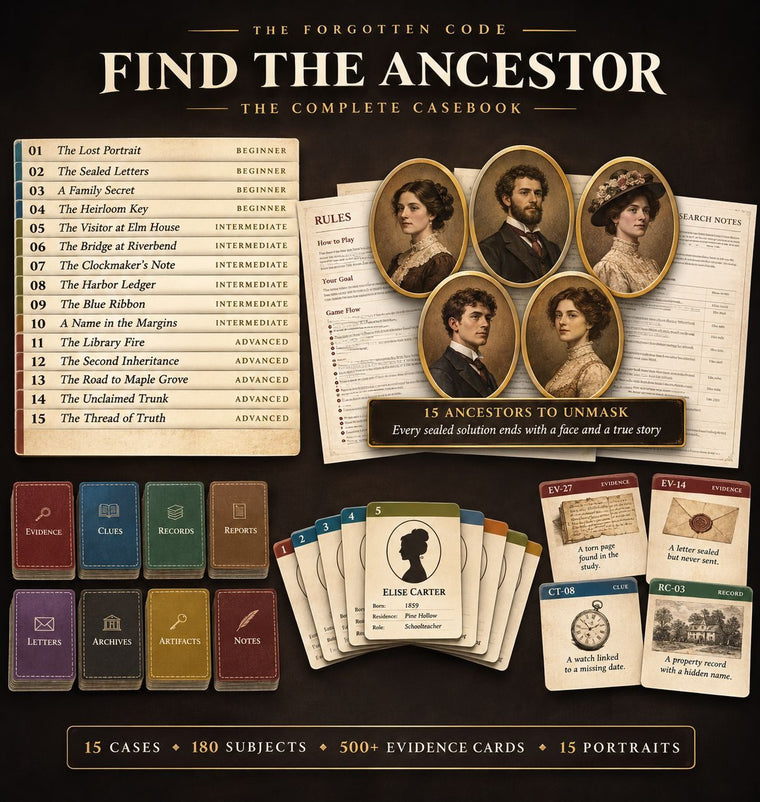
- 15 complete cases in three levels: Beginner, Intermediate, Advanced
- 180 suspect cards and 500+ evidence and archive cards
- 15 sealed solutions, each with the ancestor’s portrait and true story
- Core Kit: illustrated rules, quick-reference cards, Archivist guide
- A Family Album to collect every ancestor you find
- 2–5 rival players, plus Solo and Co-op modes
- 20–60 minutes a case, ages 12+, no genealogy knowledge needed
- Available in 4 languages: English, Español, Deutsch, Français
Somebody lost a woman two hundred years ago
A stranger writes to you. Somewhere in the hill country, two centuries back, lived a woman no one in her family can trace. Twelve people could be the answer.
You and your rivals open the same archive: censuses, chapel registers, old newspapers, family letters. Each of you already holds documents the others haven’t seen.
Some family stories are true. Some are not. The first to name the ancestor and prove it wins.
From a stranger’s letter to a face in the dark
Learn it in ten minutes. Argue about it all night. Here is one game night, step by step.
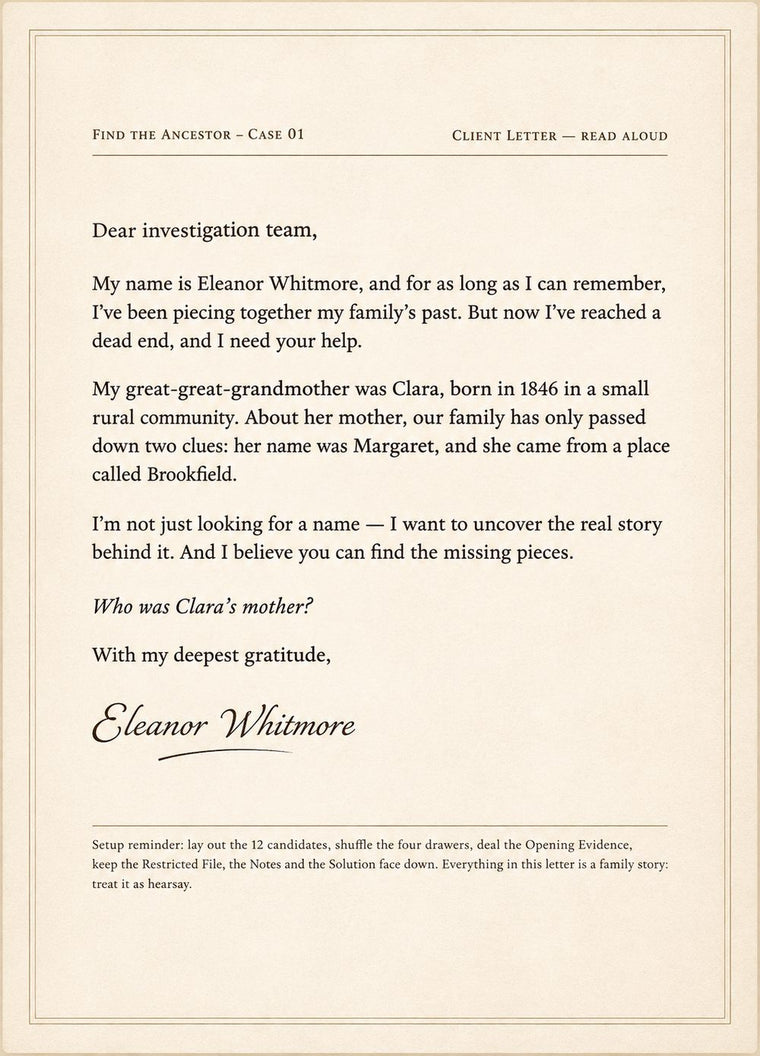
A letter arrives
Every case opens with a letter from a client who has hit a brick wall: a lost ancestor, a family legend, a handful of names and places. Read it aloud, and the hunt begins.
Listen closely. Every detail in the letter is a clue, and some of them are wrong.
Twelve suspects hit the table
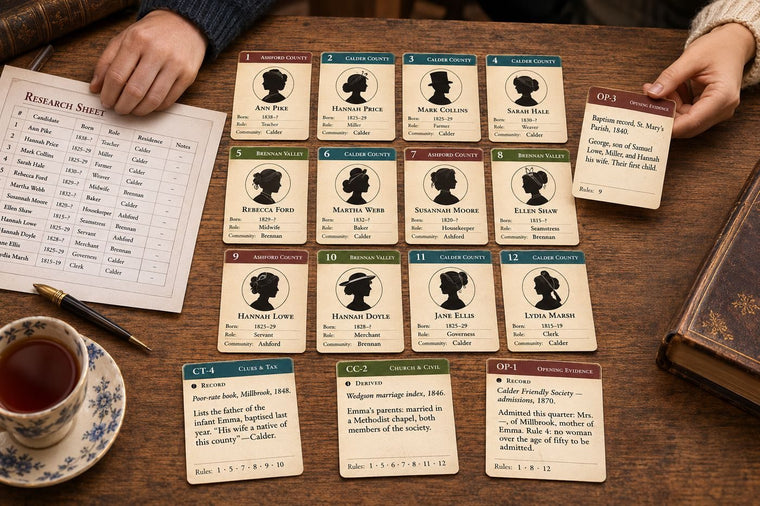
Lay out twelve candidate cards. Each one shows when she was born, her husband’s trade, her chapel and her county. One of them is the client’s ancestor. The other eleven have to go.
Every player also holds secret documents nobody else has seen.
Dig, question, bluff
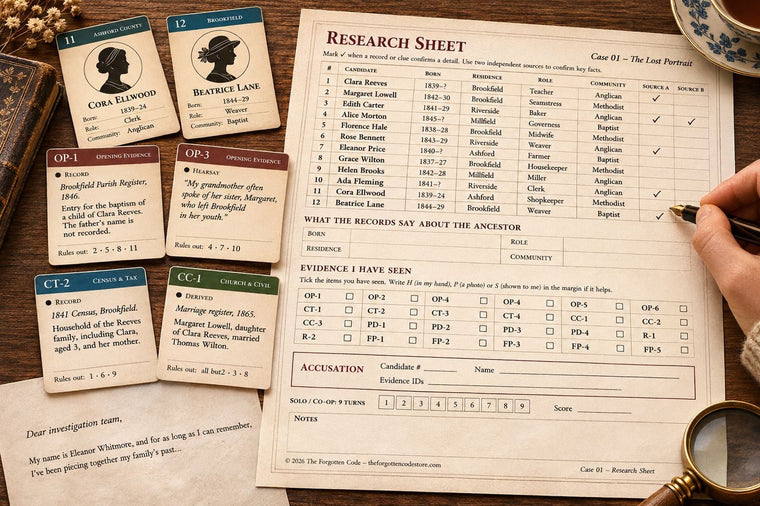
On your turn, search the archive, question a rival or chase a lead into the sealed records. Every census, register and letter rules someone out, and you track it all on your Research Sheet. Share too much and a rival gets there first.
Watch the seals: a Record beats a family story every time.
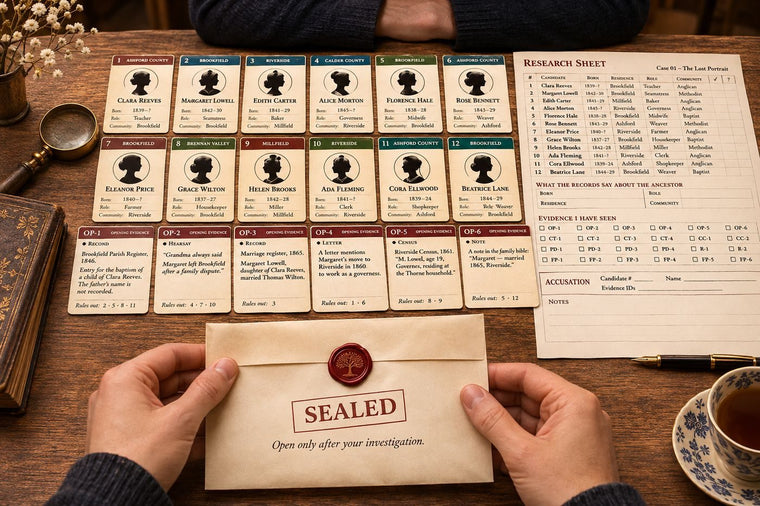
Accuse, prove it, meet her
When you think you know, name her and lay down three documents as proof. Get it right and you break the seal: her portrait, her real name and the story the family got wrong. Get it wrong and you’re out of the race.
The first to prove it wins. Being right is not enough.
Family stories lie. Records don’t.
Every document carries a seal that tells you how far you can trust it. Read the seals right and you’ll beat the table.
Record
Rules out on its ownOriginal registers, censuses, burial entries. The strongest evidence on the table.
Derived
Loses to a RecordIndexes, transcripts, obituaries, directories. Useful, but copied by someone, somewhere.
Hearsay
Never proves anything aloneFamily letters, Bibles, online trees. They point the way, and sometimes they point the wrong way.
Every person and document in the game is invented. The method is real: it’s how genealogists work every day.
Can you find her in 60 seconds?
Four suspects. Four documents. One of them is misleading you. Read the seals, rule the others out, then check your answer.
Agnes Wren
Born1820–24
HusbandWeaver
ChapelMethodist
Lydia Marsh
Born1825–29
HusbandMiller
ChapelMethodist
Clara Thorne
Born1825–29
HusbandWeaver
ChapelMethodist
Edith Pryce
Born1820–24
HusbandWeaver
ChapelBaptist
“Calder County. Listed as the wife of a weaver.”
“Baptized at the Methodist chapel, Calder.”
“Grandmother always said she was born in 1827.”
“Died 1891, aged 69.”
It’s Agnes Wren.
The census rules out Lydia Marsh, who lived in Ashford and married a miller. The chapel register rules out Edith Pryce, a Baptist. The burial index puts the birth around 1822, which rules out Clara Thorne.
The family letter pointed straight at Clara, but Hearsay can never prove anything on its own. In the real game the documents are split between rivals, and nobody shows you theirs.
The Complete Casebook
- 15 cases in three levels, each one adding a twist of its own
- The Core Kit: illustrated rules, quick-reference cards, Archivist and Solo/Co-op modes
- For every case: 12 candidate cards, evidence and archive cards, a Research Sheet and the client’s letter
- A sealed solution with the ancestor’s portrait and the true story
- A Family Album to collect every ancestor you find
- A4 and US Letter, in Color and Low-ink versions

Start easy. End brilliant.
Every case is played once, and every case teaches you something the next one will test.
Learn the archive
Every card tells you who it rules out. Perfect for a first game night with friends or family.
20–30 minutesRead between the lines
Fewer hints, more traps. Each case brings a new rule: witnesses, name variants, records in a different hand.
30–45 minutesProve it the hard way
No hints at all. Burned archives, conflicting records and a three-generation finale.
45–60 minutesAnyone who loves a good mystery
Game nights
A fresh deduction game for 2–5 friends, with a real winner.
Families
Ages 12 and up. Grandparents finally get to show off.
Family historians
Real research methods, turned into a game you can share.
Classrooms and clubs
Archivist mode lets one person run the game for a group.
Reviews
A different kind of game night

We all had a different theory, and nobody wanted to show their best evidence. Comparing notes and trying to prove each other wrong was the best part of the evening.
Julia S.We nearly opened it too soon

We thought we had the answer, then one detail sent us back through the cards. Keeping the solution folded away made that final check much more satisfying. My advice: don’t rush just because you’ve found a name that seems to fit.
Daniel M.I trusted the wrong story

I was convinced I’d found the answer until a record contradicted the family story. Having to rethink my theory made the mystery much more interesting than simply collecting clues.
Mark K.Not every clue deserves your trust

My favorite part was figuring out which sources to trust. A family note can sound convincing until a record tells a different story. Comparing the cards felt more interesting than simply collecting clues and guessing who the ancestor was.
Sophie L.A proper investigation

I played this one on my own and really enjoyed taking my time with the documents. The Research Sheet helped me keep track of what I actually knew, rather than what I was assuming. The story gave me a reason to care about the answer.
Emma R.The reference cards

We read through the rules together before starting and kept the reference cards beside us. We checked them a few times during the first case, especially when deciding what counted as evidence. Having the turn options right there was genuinely useful.
James T.Get the Complete Casebook
- 15 complete cases in three levels: Beginner, Intermediate, Advanced
- 180 suspect cards and 500+ evidence and archive cards
- 15 sealed solutions, each with the ancestor’s portrait and true story
- Core Kit: illustrated rules, quick-reference cards, Archivist guide
- A Family Album to collect every ancestor you find
- 2–5 rival players, plus Solo and Co-op modes
- 20–60 minutes a case, ages 12+, no genealogy knowledge needed
- Available in 4 languages: English, Español, Deutsch, Français
We’re The Forgotten Code
We turn the way genealogists really work into games you play around a table. Censuses, chapel registers, old newspapers, family letters, and the family legends that lead you the wrong way.
Every name and every document is invented. The method is real: rule people out, weigh every source, and give a forgotten person back her name. We built Find the Ancestor for that moment, when the right record clicks into place.
- ✦ A real method. Records, hearsay and derived sources work the way they do in real research.
- ✦ Invented lives. Every family, village and letter was written from scratch for the game.
- ✦ Made for the table. Print it, gather your rivals and argue about the evidence all night.
Happy hunting,
The Forgotten Code
Stuck on something? Write to us.
A question about printing, a rule you’re not sure about, or your order: send us a message and we’ll reply by email.
Please don’t ask us for the solution. Break the seal instead.
Before you play
Do I need to know anything about genealogy?
No. The rules explain everything in about ten minutes. If you love genealogy, you’ll recognize the method, and enjoy it even more.
How do I receive it? Is it a physical product?
It’s an instant PDF download: the files are yours right after checkout, in A4 and US Letter, Color and Low-ink. Print them at home or at a copy shop, cut the cards and play the same evening. Nothing is shipped, and you keep lifetime access.
Which languages is it available in?
Find the Ancestor is available in four languages: English, Spanish (Encuentra al antepasado), German (Finde den Vorfahren) and French (Retrouvez l’ancêtre). Every language edition is the complete game, in A4 and US Letter, Color and Low-ink.
How many people can play?
2 to 5 players, best with 3 or 4. There’s also a Solo and Co-op mode, and an Archivist mode where one person runs the game for a group.
How long does a case take?
Beginner cases take 20–30 minutes, Intermediate 30–45 and Advanced 45–60.
Can I replay a case?
Each case is solved once, like an escape room. That’s why the Casebook includes 15 of them. You can print as many copies as you need to play with different groups.
What do I need to print it?
A home printer and regular paper are enough. Card stock of 160–250 gsm makes the cards feel great. A Low-ink version is included.
Every person, family and document in Find the Ancestor is invented. For personal and household use.
Add more to your investigation.
Extras built to work with the cases of your Complete Casebook.
Instant download · Secure checkout · 30-day guarantee